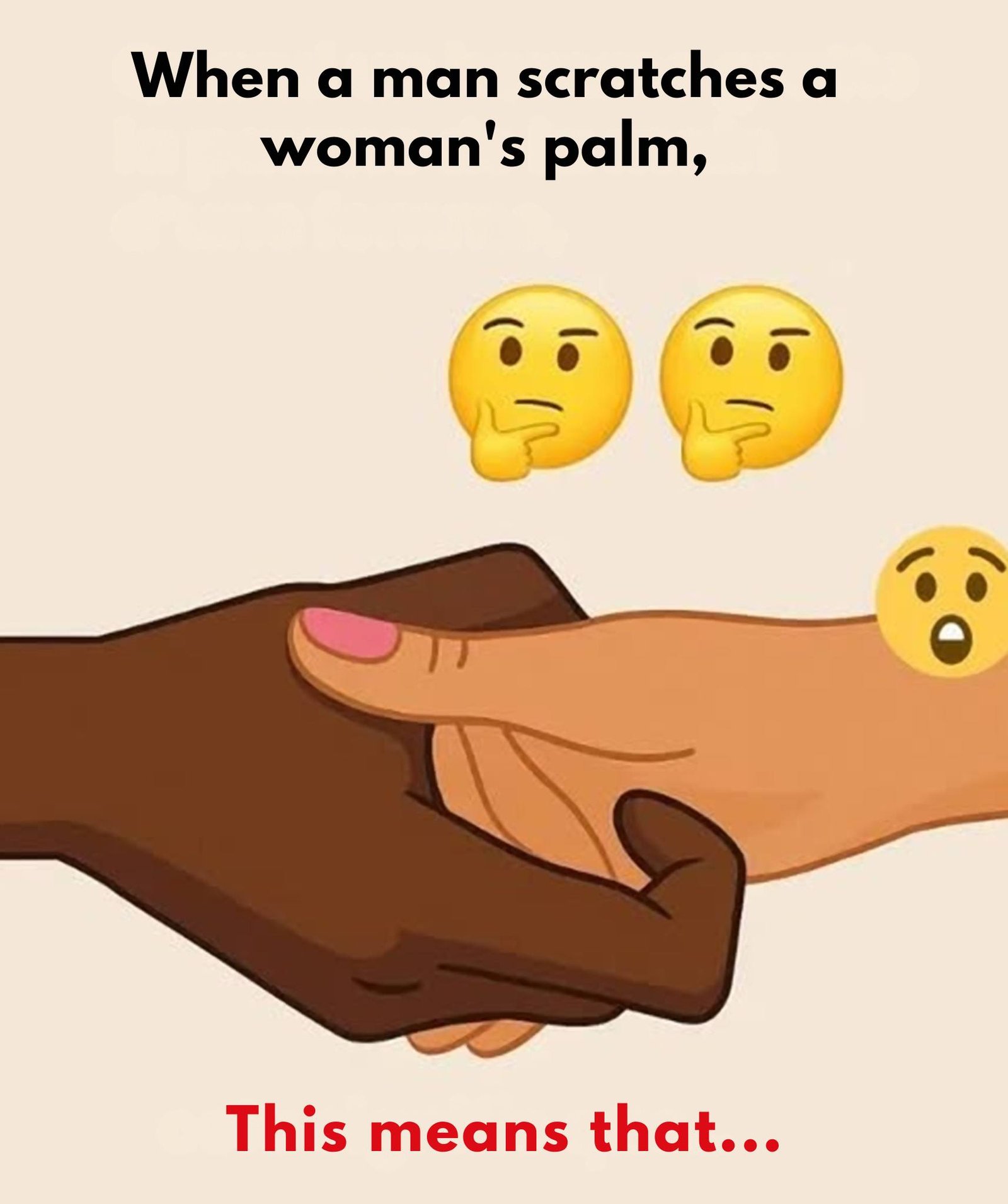
Sometimes a gesture is so small that it almost goes unnoticed. A handshake lasts a second longer than usual, fingers shift slightly, and one person lightly scratches the other’s palm. Moments like that can leave people wondering whether the gesture carried a hidden meaning or if it was simply accidental.
Because the palm is a sensitive part of the hand, a touch there can feel more noticeable than expected. For that reason, some people interpret the gesture as a quiet signal. Others see nothing unusual about it. In reality, the meaning often depends on the situation, the culture, and the people involved.
Often linked to subtle flirting
In certain social contexts, lightly scratching someone’s palm during a handshake or brief touch is sometimes interpreted as a subtle form of flirting. The idea is that it allows someone to test a connection without openly expressing attraction.
This kind of gesture usually appears in relaxed situations where two people are already comfortable with each other. There may be eye contact, easy conversation, or playful body language. In that setting, the movement can function as a quiet way to see how the other person reacts.
However, it is important to remember that this interpretation is not universal. Not everyone who makes this gesture intends it as a romantic signal.
Culture can change the meaning

Body language varies widely around the world. A gesture that means one thing in one culture may carry a completely different message somewhere else.
In many Western countries, scratching someone’s palm during a handshake might simply be ignored or seen as meaningless. Some people may not even notice it.
In parts of Africa and the Caribbean, however, the gesture is sometimes understood as a sign of romantic or sexual interest when it happens during a handshake. In that cultural context, the signal may be more widely recognized.
In many Asian cultures, where public physical contact tends to be more restrained, the same gesture might feel confusing or inappropriate rather than flirtatious.
Because of these differences, it is difficult to interpret the gesture without understanding the cultural background of the people involved.
Sometimes it means nothing at all
Another possibility is that the movement is completely unintentional. Many people have small nervous habits involving their hands. They rub their fingers together, adjust their grip, or shift their hands without thinking.
In those cases, the scratching motion may simply be part of that unconscious movement.
It can also be a playful action used during a friendly interaction. Someone who is relaxed or joking around might make the gesture without attaching any deeper meaning to it.
Context is the best clue
When trying to understand any nonverbal signal, the wider context usually matters more than the gesture itself.
Consider the situation. Was the interaction casual or professional? What was the overall body language like? Were there smiles, prolonged eye contact, or signs of nervousness?
If the gesture happens only once, it may have been accidental. If it occurs repeatedly in a similar context, it might suggest a deliberate signal.
Most importantly, pay attention to how the interaction felt. Personal comfort often provides the clearest guidance.
Respect and personal boundaries
Regardless of intention, physical contact should always respect personal boundaries. If a gesture like this makes someone uncomfortable, that feeling is valid and worth acknowledging.
A simple response can be enough. Pulling your hand away, shifting posture, or calmly expressing discomfort can signal that the contact was not welcome. Someone acting in good faith will usually respect that immediately.
The simple truth behind the gesture
Scratching someone’s palm can mean different things depending on the circumstances. It might be a quiet flirtation, a cultural signal, a playful action, or simply an unconscious movement.
Body language is rarely universal or easy to decode. The real meaning of a gesture comes from the context around it, the relationship between the people involved, and how the moment feels to those experiencing it.